OpenAI has begun a limited preview of GPT-5.6 Sol, Terra, and Luna — a three-model family for frontier reasoning, production workloads, and cost-efficient routing via the API and Codex.
OpenAI is previewing GPT-5.6 Sol, its next-generation flagship model, alongside Terra and Luna in a phased rollout for developers and enterprises. Announced on June 26, 2026, the GPT-5.6 family advances software engineering, computer use, professional knowledge work, scientific research, and cybersecurity. During the preview, Sol reaches trusted partners through the OpenAI API and Codex only; GPT-5.6 is not available in ChatGPT yet, and OpenAI has not set a general-availability date.
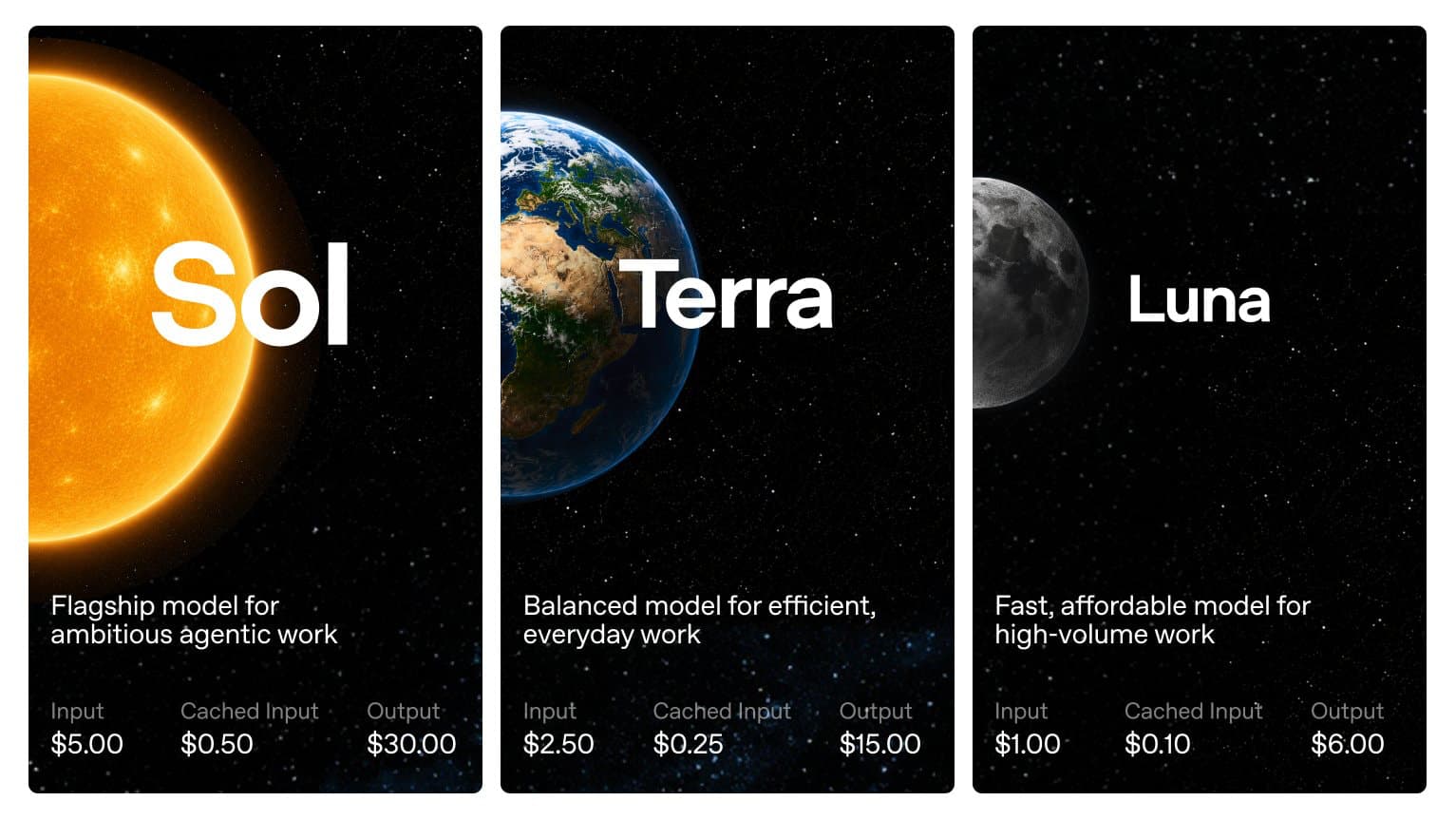
Sol is built for frontier reasoning and long-horizon agentic work. OpenAI reports new highs on Terminal-Bench 2.1 for command-line workflows that require planning, iteration, and tool coordination. On ExploitBench cybersecurity tasks, Sol achieves competitive results while using roughly one-third the output tokens of another leading frontier system. Biology benchmarks also climb about nine percentage points above GPT-5.5, including 53.5% on the Virology Capabilities Test. GPT-5.6 introduces a max reasoning effort setting and an ultra mode that deploys subagents to accelerate complex jobs. Terra offers GPT-5.5-competitive performance at half Sol's cost; Luna is the fastest, most affordable tier for classification, routing, and high-volume preprocessing.
API pricing is tiered per million tokens: Sol at $5 input and $30 output, Terra at $2.50 and $15, and Luna at $1 and $6. GPT-5.6 adds more predictable prompt caching with explicit cache breakpoints, a 30-minute minimum cache life, cache writes at 1.25× the uncached input rate, and a 90% discount on cache reads. As part of ongoing U.S. government engagement, OpenAI previewed capabilities ahead of launch and is starting with a limited trusted-partner cohort before broader release. Its GPT-5.6 Preview System Card rates Sol, Terra, and Luna High on cybersecurity and biological risk but below Critical for AI self-improvement. Independent evaluator METR found no robust evidence that Sol would enable fully automated AI R&D.
OpenAI plans to expand availability across ChatGPT, Codex, and the API as soon as possible. Read more: Previewing GPT-5.6 Sol: a next-generation model.
Original Sources
Disclaimer
This is an AI-summarized article from authoritative sources. If you want your content removed, please .